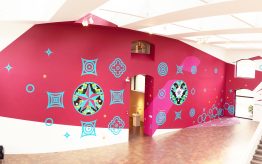
Image: Courtesy of Coventry (RI) Public Library
Teen services librarians have been innovating and spreading connected learning approaches ever since the framework was first developed. This post describes how the Coventry (RI) Public Library has put connected learning into practice, a reflection motivated by a collaborative research project with the Connected Learning Lab. It is also a teaser and the fourth of a series of blog posts tied to recently released project report, Transformative Outcomes Through Community Engagement: How Public Library Staff Can Foster Connected Learning Teen Services.
A three-year project funded by IMLS, the Transforming Teen Services for Equity, Diversity, and Inclusion (TS4EDI) project investigated the challenges library staff face and the support they need for designing and sustaining connected teen learning experiences, including in rural and small libraries. Researchers engaged in:
The project produced reports tailored to public library leadership and teen services staff, with key findings and recommendations, as well as checklists for how to put connected learning in practice. These publications, and related resources for library leaders, staff, and researchers can be found on the Connected Learning through Libraries resource page of the Connected Learning Alliance. |
During my time as a Teen Librarian, I continually seek ways to connect with teens, learn from them, and engage them meaningfully. My goal has been not only to welcome them into the library but also to understand how the library can support their interests and identities. Reading Transformative Outcomes Through Community Engagement: How Public Library Staff Can Foster Connected Learning Teen Services, I found myself agreeing with its points and reflecting on our current practices and ideas for enhancement.

Image: Make A Mug Summer Program 2023. Courtesy of Coventry (RI) Public Library.
One challenge highlighted in the report is the difficulty of getting away from “the desk.” I appreciate Niq Tognoni’s (Nashville Public Library) idea of having someone “float” around to engage with patrons. However, this can be challenging with staff limitations and space constraints. I have found passive activities to be helpful in engaging teens in their interests. Gathering suggestions for in-house-made bookmarks and pins featuring favorite musicians, shows, and book recommendations has been an effective way to understand and reflect our teens’ interests. If I relied solely on my interests, I might miss connecting with some teens.
Reflecting on relationship-building, I think about the Dungeons & Dragons program I facilitate. Initially, I was nervous about being a Dungeon Master (DM) for a group of teens because I wanted them to have fun and feel comfortable. Now, after several years, the program has become a place where I can get to know teen interests. We chat, eat, and play the game. Initially, the program was bi-weekly or monthly, but as interest grew, I began offering it weekly. Despite space constraints, with the consent of my director, we moved the program to our staff break room. Over the years, I’ve watched the participants grow and become more confident. One teen, who didn’t know how to play at the start, is now an experienced player who helps others. It has become a great space for them to have fun and gain confidence.

Image: Courtesy of Coventry (RI) Public Library
The report also made me realize the importance of expanding partnerships with community members for teen events and services. I loved what the Memphis Public Library did with professional filmmakers that led to films screened at the Indie Memphis Youth Film Fest. While I try to partner with schools and other town departments, the report highlighted many opportunities for community partnerships to improve services and engage in a wide array of teen interests. Our library co-hosts a trivia event at a local restaurant, placing the event in a fun and relaxed environment. Library staff usually form a trivia team and participate allowing us to engage with and learn about our community members. This approach reaches those we might not typically see at the library.
Unfortunately, participation numbers often overshadow the impact of our programs. It’s easy to get discouraged by low attendance, but the connections formed with those who do attend are invaluable. Using connected learning principles such as forming connections, engaging with the community, and learning about teen interests builds relationships that have impact. I’ve begun to reflect on how low attendance still allows me to form connections with teens. Moving forward, I plan to focus not only on attendance numbers but also on feedback from teens. I love what Kevin Awakuni from the Los Angeles Public Library does with Talkback Boards at the end of his programs – what a great way to interact with teens and gather feedback.

Image: 2023 Pickle Autopsy. Courtesy of Coventry (RI) Public Library.
Professional development support is crucial, not only for library-related learning but also for non-library-related topics. Expanding beyond library peers and learning from other professionals can spark new ideas and thinking. This past year, I hosted a Pickle Autopsy event, where teens acted as forensic scientists to solve the mystery of what happened to their “pickle victim.” This program was actually inspired by a science teacher and it was a strange, new idea that turned out to be a hit. It gave me confidence in trying new programs and stepping outside my comfort zone.
This report made me reflect on my interactions and learning with teens and how I can improve my connections. The findings on connected learning are eye-opening, and I hope to use them as I continue in my career. Enhancing connections and making libraries a welcoming space for teens is essential. Teen voices should be heard, welcomed, and given a space in libraries.
Guest Post by Kylie Woodmansee
 Kylie Woodmansee is the Young Adult and Youth Services Librarian at Coventry Public Library in Coventry, RI. She graduated in 2021 from Clarion University with her Masters in Information and Library Sciences and has been the teen librarian for the past four years. She is a part of the Rhode Island Teen Book Award committee and the Rhode Island Middle School Book Award committee.